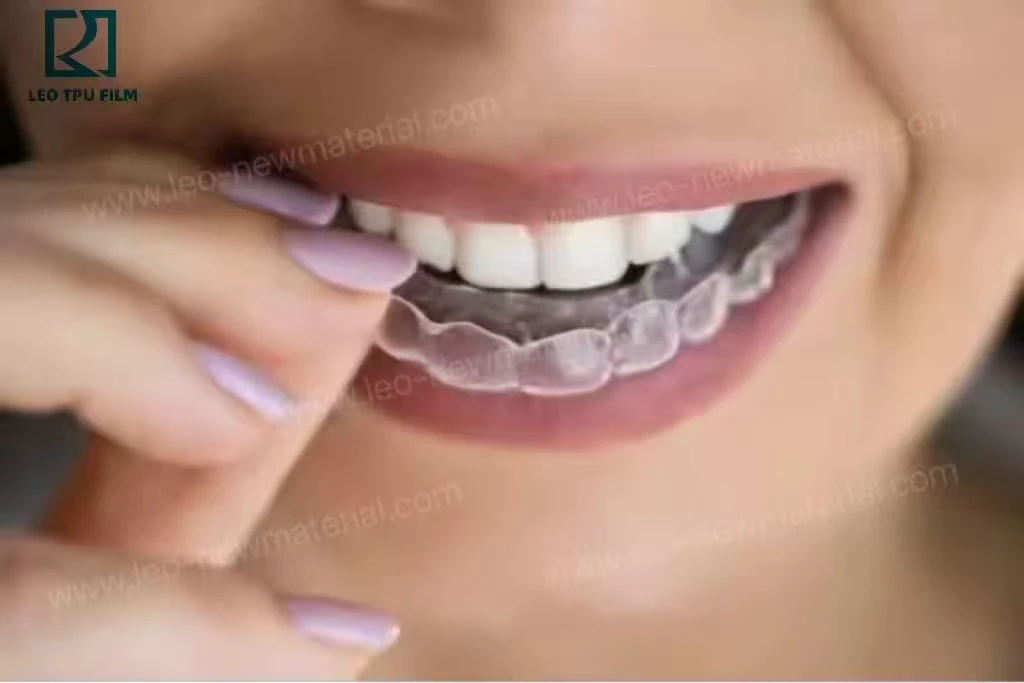
When people think of invisible orthodontic treatment, their first impression is usually "transparent and aesthetically pleasing, with easy removal and insertion." When selecting materials, many fabrication facilities and clinics prioritize comparing the transparency of the material, often overlooking the substrate itself; however, the substrate is the core factor determining the orthodontic experience and clinical outcomes. In the era of traditional metal brackets, orthodontic treatment relied on rigid metal wires to move the teeth, resulting in significant discomfort and poor aesthetics. Following the widespread adoption of transparent appliances, PETG rigid materials were the first to see broad application; they offer high transparency, simple fabrication, and controllable costs, making them highly popular for basic alignment and short-term retainer use.
However, with extensive clinical experience, the limitations of rigid materials become apparent. PETG is a rigid plastic that lacks inherent elasticity; its force application mechanism involves instantaneous, concentrated pressure. When teeth are subjected to sudden external forces, patients experience pronounced soreness and tension, experience greater stress on the tooth roots, and are more likely to experience tooth rebound. Moreover, because PETG has high edge hardness, even a slight misalignment in the fit of the orthodontic appliance can cause continuous friction against the oral mucosa, leading to oral ulcers; consequently, patient complaint rates at follow-up visits remain consistently high.
Orthodontic appliances require repeated daily removal and cleaning; the repeated bending and pulling throughout the day cause PETG to develop stress-induced whitening at the bending points. With prolonged use, the material may crack or develop frayed edges, resulting in a very short effective service life for each set of appliances and indirectly increasing the patient's orthodontic treatment costs.
The introduction of medical-grade TPU elastic substrates has effectively addressed these shortcomings; they combine shape-retention capability with elastic resilience, providing a gradual force release that delivers a gentle and stable force over time, thereby aligning with the clinical principle of orthodontics: "using gentle force to guide the slow movement of teeth."
In high-complexity cases-such as those involving complex dental arches, extraction-based orthodontic treatment, and fine-tuning-the advantages of TPU are further amplified: the material's elasticity buffers pressure, allowing forces to be distributed evenly and thereby significantly reducing discomfort during wear; meanwhile, its excellent tear resistance and flexural durability make it less prone to damage during repeated removal and reinsertion.
Of course, material selection is not a matter of choosing between two extremes: for simple cases and short-term retainers, PETG remains a suitable option; for complex orthodontic corrections and a focus on long-term wearing comfort, medical-grade TPU offers a more reliable solution. Matching the appropriate material to the complexity of the case and the patient's needs is the correct approach to selecting orthodontic materials.