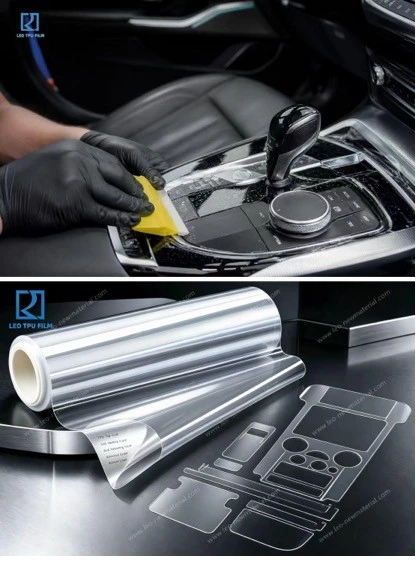
In today's automotive interior material selection, requirements for heat resistance, wear resistance, low odor emission, and environmental compliance have become mandatory industry standards. Thermoplastic polyurethane film-commonly known as TPU film-is increasingly expanding its application scenarios in automotive interiors, with a growing number of automakers incorporating it into their interior design solutions.
I. Stringent in-vehicle environment requirements: interior materials must meet five key performance criteria
The internal environmental conditions of a vehicle cabin are far more complex than they appear to the naked eye. Under intense summer sunlight, the dashboard and door panels can remain exposed to high temperatures for extended periods; in contrast, during cold winter months, many interior materials may become hardened and brittle. Coupled with repeated daily handling, bending, and friction, the sealed cabin can also amplify unpleasant odors, leaving very limited tolerance for degradation of these interior materials.
To meet automotive interior application requirements, interior materials must satisfy five key criteria: heat resistance, wear resistance, low odor emission, stable mechanical properties, and superior visual appeal and tactile quality. If any of these criteria is inadequately met, potential quality issues may emerge during vehicle operation. TPU film does not excel in any single performance metric; instead, it offers balanced and stable overall performance with virtually no significant shortcomings-this is a key reason why interior designers highly value this material.
For material suppliers, relying solely on a single test report is often insufficient to secure a place in the complete vehicle supply chain. During the project development phase, the critical threshold for market access lies in whether they can align all technical specifications with the OEM and Tier 1 suppliers in the early stages of the project, while ensuring consistent performance in mass production.
II. Four Key Advantages of TPU Film in Interior Applications
✅ Exquisite appearance and tactile feel
TPU film features a refined tactile feel and supports various surface treatment options- including matte, transparent, or custom color schemes. When used as an interior decorative layer, protective layer, or functional layer, it can directly enhance the visual appeal and tactile experience of a vehicle's interior, making it a crucial detail in crafting the premium interior quality of high-end automotive models.
✅ Wear-resistant and flexure-resistant, ideal for high-frequency application environments
Door armrests, instrument panel trim strips, function button zones, and seat side panels
are all frequently touched areas within the vehicle interior. TPU film retains its structural integrity even after repeated friction and bending, making it a superior choice over conventional materials for such high-frequency, long-life application scenarios.
✅ Low odor, compliant with VOC environmental control regulations
Automotive manufacturers are continuously tightening their standards for controlling VOCs (volatile organic compounds) and odors within vehicles. By utilizing compliant TPU materials developed through formulation and process optimization, these manufacturers can easily meet relevant environmental regulations, thereby helping component suppliers streamline their testing and certification processes. For export-oriented vehicle models, such performance characteristics can also comply with the market access requirements of multiple overseas markets.
✅ Excellent composite processing properties
TPU film can be compounded with various substrates-including leather, fabric, and foam - combined with a hot-melt adhesive film process. This approach enables it to accommodate interior components of diverse designs, thereby expanding creative possibilities for automotive interior styling. Its wide range of process compatibility allows a single material to be applied to a variety of interior parts.
Ⅲ ,LEO New Materials: One-stop R&D and supply services for automotive interior TPU films
In the implementation of the interior TPU project, ensuring stable supply capabilities and seamless process integration is often more critical than adhering to a single performance metric.
LEO New Materials (Yantai LEO New Materials) is headquartered in Yantai, Shandong Province. With over a decade of expertise in the R&D, production, and export of TPU films, the company has established its office and R&D center in Yantai, while deploying its production bases across the Yangtze River Delta and the Pearl River Delta regions, thereby achieving efficient synergy between its R&D capabilities and production capacity.
In addition to automotive interior TPU films, we also offer waterproof and breathable TPU films, TPU hot-melt adhesive films, automotive paint protection film (PPF), as well as a variety of functional films-including PET, PES, and TPEE-along with complementary TPU granules and sheet products. Our product portfolio meets diverse requirements across interior composite applications, vehicle body protection, and industrial lamination, with products exported to numerous countries and regions across the Asia-Pacific, Southeast Asia, Europe, the United States, and Africa.
We offer comprehensive supporting services to automotive interior customers, primarily encompassing three key areas: selecting appropriate components based on their application locations and coordinating sample preparation; assigning dedicated personnel to monitor the entire production process and conduct finished-product testing; and providing uninterrupted online after-sales support. Given that automotive interior projects typically involve extended timelines and numerous validation stages, efficient early-stage collaboration is critical to ensuring the smooth progression of subsequent mass production
-a key consideration that is often overlooked when selecting material suppliers.
If you are evaluating automotive interior TPU films for your project, you are welcome to visit the official website of LEO New Materials at www.leo-newmaterial.com to browse our TPU film product information; alternatively, you may send an inquiry email to lee@leo-newmaterial.com specifying the intended application areas and your performance requirements.