I.Primary Application Scenarios
This high-performance TPU film-characterized by low moisture transmission and high barrier properties-offers balanced protective performance, making it suitable for a wide range of protective gear applications.
1. Heavy-duty industrial tooling: Integrated tooling systems and protective clothing designed for applications in mechanical machining, smelting, petrochemical processing, and other similar scenarios; these solutions provide wear-resistant protection while preventing the penetration of various chemicals.
2. Chemical-resistant protective clothing (chemical suits): Used in industries such as chemical processing, pharmaceuticals, and hazardous chemical storage, these suits provide protection against corrosive agents-including acids, bases, and organic solvents-and represent one of the most typical application scenarios for TPU barrier materials.
3. Acid-and alkali-resistant, anti-fouling/anti-oil-staining industrial equipment: Designed for specific media such as sulfuric acid, sodium hydroxide, and machine oil, providing targeted protection.
4. Emergency rescue protective gear: A core material for protective equipment in firefighting and hazardous chemical leak response scenarios.
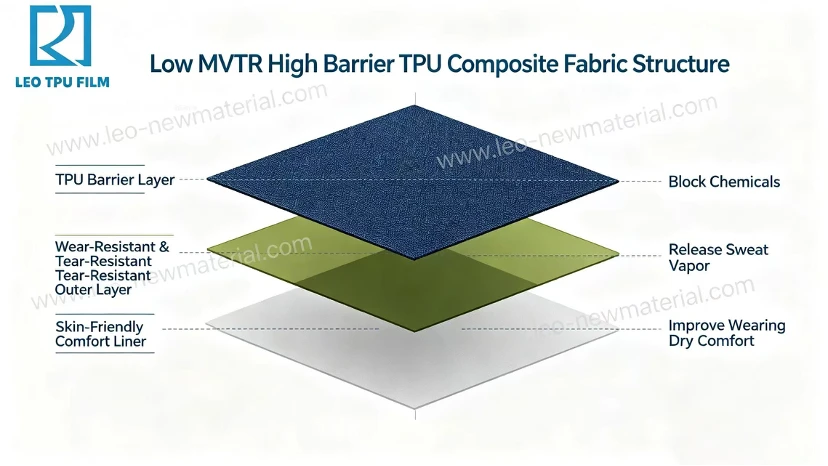
In such applications, the TPU barrier layer can be combined with a flame-retardant outer fabric and a moisture-wicking inner lining to create multi-layer composite fabrics that meet the required protection ratings.
II. Key Considerations for Procurement and Product Selection (Checklist for Procurement Decision-Makers)
If you are selecting film materials for industrial applications or protective equipment, we recommend referring to the following selection criteria:
1. Define protection requirements: Identify the types and concentrations of chemicals present in the work environment, distinguish between exposure routes (e.g., splashing, immersion, vapor), and determine the required protection level in accordance with applicable protection standards.
2. Verify actual barrier performance data: Request from suppliers the penetration time for the specific medium and medium resistance test data; do not rely solely on generic descriptors such as "chemical resistance" when selecting materials.
3. Balancing moisture transmission and barrier performance: Evaluate moisture transmission performance in conjunction with work intensity and wearing duration; safety protection standards must not be compromised in pursuit of wearing comfort, nor should they be compromised for the opposite reason.
4. Verification of durability metrics: Focus on reviewing test data for tensile strength, tear resistance, wear resistance, and low-temperature bending to assess the service life of the material under actual operating conditions.
5. Verify compliance qualifications: Confirm whether the product meets relevant standards, such as the EU EN standards and U.S. standards for protective equipment, and request the corresponding certification documents.
6. Evaluate supplier capabilities: Confirm that the supplier can consistently ensure batch consistency, support customization of thickness and color, and possesses a stable and sustained supply capacity.
III. Frequently Asked Questions (FAQ)
1: Is the low-moisture-permeability, high-barrier TPU film suitable for all chemical-resistant applications?
A: This material is more suitable for scenarios involving splashing of liquid chemicals or short-duration, limited-duration immersion; its breathability also exceeds that of fully enclosed, airtight protective products. However, for extreme operating conditions-such as exposure to gaseous chemicals or prolonged immersion at high concentrations-it is necessary to select specialized protective materials with a higher airtightness rating. It is recommended to conduct a comprehensive evaluation based on both the specific field conditions and relevant industry standards.
2: Is a lower moisture transmission rate always better?
A: That is not the case. An excessively low moisture transmission rate can lead to a stuffy and humid environment inside the protective suit, thereby increasing the risk of heat stress; conversely, an excessively high moisture transmission rate can compromise its barrier and sealing performance. The ideal approach is to maintain the moisture transmission rate within an appropriate range while still achieving the desired protection level.
3: What are the wear resistance and flexibility properties of TPU film?
TPU material exhibits excellent elasticity, superior wear and tear resistance, and retains its softness even in low-temperature environments; its performance surpasses that of many traditional composite fabrics characterized by a stiffer texture. All specific performance parameters shall be subject to the test report.
4: How can you determine whether the barrier performance of a TPU film meets the required standards?
The most reliable approach is to review third-party test reports to obtain the penetration duration and medium resistance data for the target chemical, and then verify the protective rating against relevant personal protective equipment standards.
5: How should TPU protective equipment be maintained?
routinely clean, dry, and store the product according to the instruction manual; avoid prolonged exposure to high temperatures and direct sunlight; before each use, inspect the barrier layer for any damage, and perform testing or replacement according to the recommended intervals; for detailed operating instructions, refer to the accompanying user manual of the equipment.
IV. Conclusion
Low-moisture-permeability, high-barrier TPU films provide a novel solution to balance safety protection with wearer comfort. Whether for heavy-duty industrial workwear or chemical-resistant protective equipment, selecting the appropriate barrier material can not only practically safeguard the personal safety of frontline workers but also enhance operational efficiency.
If you are seeking a stable-performing, customizable low-water vapor transmission and high barrier TPU film solution, please contact Yantai LEO New Material Co., Ltd. for product data sheets and sample support.