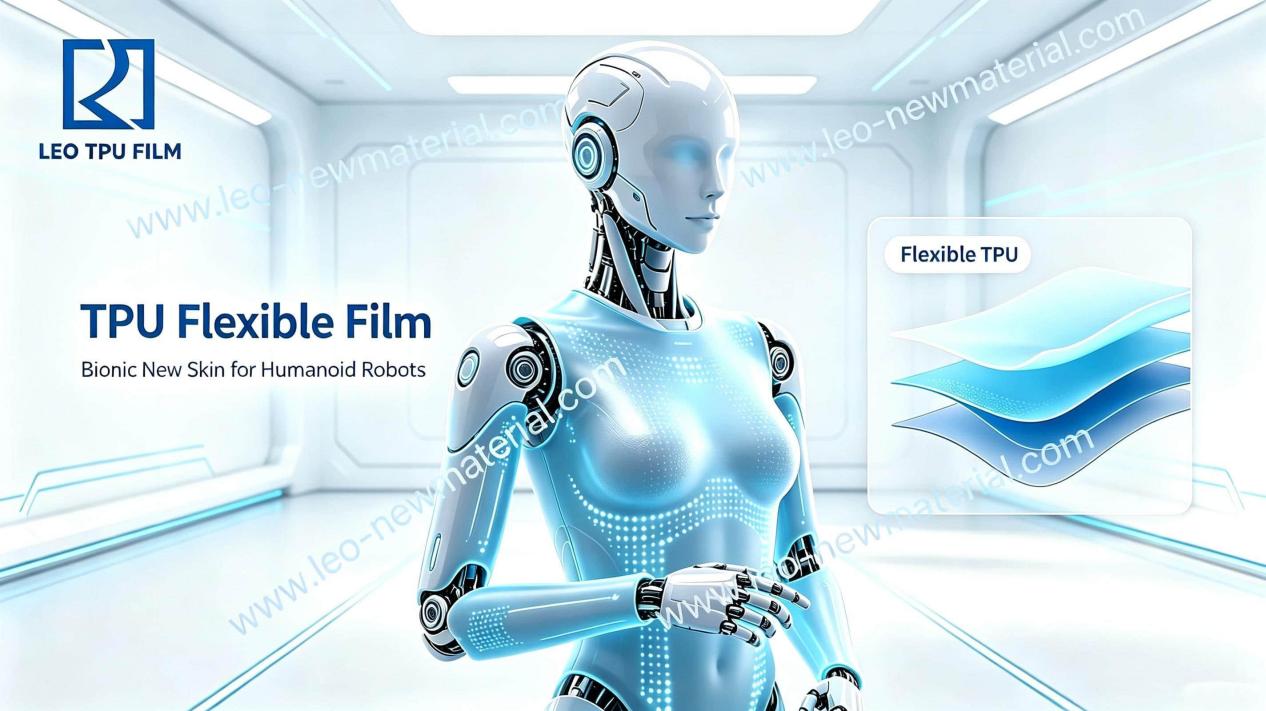
With the rapid proliferation of humanoid robotics technology, the development of softer, safer, and smarter bionic skins has become a key focus for industry advancement. Today, TPU flexible films-thanks to their exceptional flexibility-have successfully emerged as the primary material for next-generation robotic electronic skins.
Traditional robots typically employ metal or hard plastic for their casings, which not only feel rigid and lack elasticity, but also result in stiff joint motion. When there is close contact between humans and robots, such casings are prone to collisions, posing potential safety hazards. In contrast, the key characteristics of TPU material are its softness, toughness, and ability to stretch and bend freely. This property enables it to conform perfectly to a robots joints, arms, and torso, undergoing repeated deformation during wide-ranging movements while remaining resistant to cracking and wear.
Compared to conventional membrane materials, the robots surface layer-fabricated from TPU film-features a refined texture, giving the robot an overall appearance that appears more natural and approachable. Additionally, this material offers superior wear resistance, scratch resistance, and aging resistance, ensuring that it remains intact under everyday handling and cleaning conditions, thereby effectively protecting the internal sensors and structural components of the robot.
Most importantly, TPU flexible material offers superior safety cushioning properties, effectively absorbing shocks and preventing impacts during human-robot interaction. This significantly enhances the safety profile of household service robots, healthcare and caregiving robots, and industrial collaborative robots. Moreover, the material exhibits exceptional adaptability, allowing seamless integration with a wide range of sensing devices. This enables robots to accurately detect touch force and contact points, facilitating more nuanced and intelligent interactive operations.
Given current industry trends, intelligent robots are poised to evolve toward becoming softer, safer, and more human-like in the future. Leveraging its advantages-high cost-performance ratio, stable performance, and broad applicability across diverse scenarios-TPU flexible film will continue to deepen its expertise in the field of robotic bionic skin, emerging as a promising new material in the intelligent manufacturing sector.