High-moisture-permeability, waterproof TPU films are widely used in outdoor apparel, medical protective equipment, functional footwear materials, and various protective products; they are a key material among functional fabrics. Procurement officers and technical engineers frequently encounter the same challenge when selecting materials: even when using TPU raw materials of the same grade, the moisture permeability of films produced by different manufacturers can vary significantly. The root cause of this difference lies not in the raw material itself, but in the process design employed during the film forming stage.
Water vapor passes through the TPU membrane following the "adsorption–diffusion–desorption" transport pathway: the water vapor first adheres to the hydrophilic groups on the surface of the membrane, then traverses the amorphous regions formed by the amorphous segments, and finally desorbs and escapes from the other side of the membrane. In simple terms, the effectiveness of moisture permeability is jointly determined by the membrane's microstructure and its thickness; all adjustments to production parameters are made by altering these two conditions to regulate the efficiency of water vapor transport.
There are five key processing conditions that directly determine the moisture transmission rate of TPU film:
1. Film thickness: the most direct influencing variable
Water vapor transmission rate and film thickness are approximately inversely related. During the calendering, blow-forming, and calendering processes, finished-product thickness is controlled by coordinating the die gap, screw speed, draw rate, and cooling temperature. The thinner the film, the shorter the water vapor diffusion path and the better its water vapor transmission performance; however, this comes at a trade-off: if the film thickness is too low, both tensile strength and hydrostatic pressure resistance will correspondingly decrease. In actual production, a balance must be achieved between water vapor transmission performance and mechanical water resistance by taking the downstream application scenario into account.
2. Processing temperature: control the microphase separation state in the soft and hard segments
TPU forms stable moisture-permeable channels through its soft–hard segment block structure. If the melt temperature is too high, intermolecular hydrogen bonds are disrupted, which in severe cases can lead to thermal degradation of the material; if the temperature is too low, the material is not fully plastified and the melt lacks uniformity. Both conditions interfere with the water vapor transport channels and impair moisture permeability. Only by maintaining the processing temperature within an appropriate range can a microstructure be formed that facilitates the passage of water vapor.
3. Cooling rate: alter the proportion of hard-segment crystallization
The rate of cooling directly affects the degree of crystallization in the TPU hard segment:
• Rapid cooling: inhibits hard-phase crystallization and increases the proportion of the amorphous region; since the amorphous region serves as the primary pathway for water vapor diffusion, moisture permeability is improved.
• Slow cooling: The crystals grow fully, the membrane structure becomes dense and compact, diffusion resistance for water molecules increases, and water permeability decreases
4. Stretching process: two possible outcomes for the orientation of dense films and microporous films
The effect of stretching on moisture transmission can be categorized into two operating conditions:
• Dense TPU film: After unidirectional orientation and stretching, the molecular chains are arranged in an orderly fashion, the free volume is reduced, and moisture permeability is decreased.
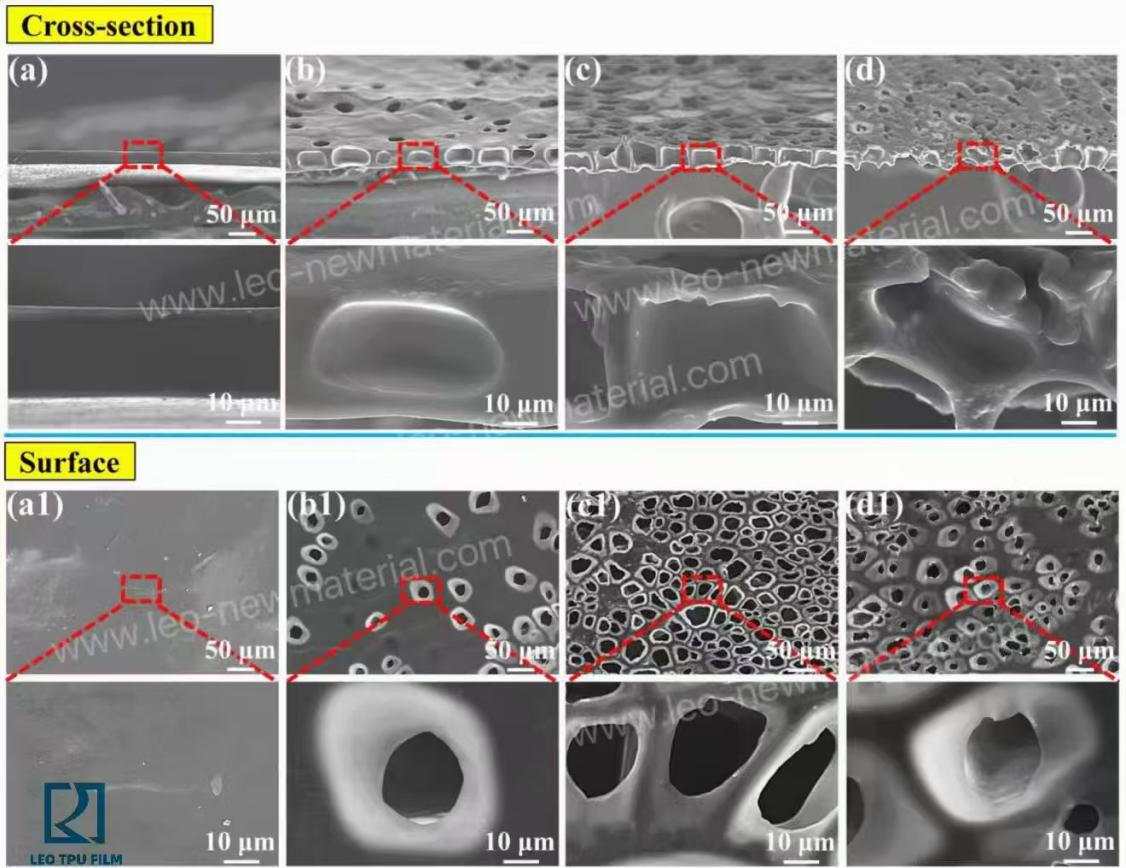
• Preparation of microporous TPU films via biaxial stretching: After stretching, continuous microporous channels are formed within the material, allowing water vapor to pass directly through the micropores and thereby increasing moisture permeability by an order of magnitude; this approach is also commonly employed for high-moisture-permeability fabrics.
5. Post-annealing treatment and substrate selection
Post-processing steps such as annealing alter the crystalline state and degree of microphase separation of the film; they are commonly used to optimize dimensional stability and water resistance, but they also cause fluctuations in moisture transmission performance, necessitating a comprehensive trade-off. At the material level, polyether-based TPU inherently contains ether linkages, giving it superior hydrophilicity compared with polyester-based TPU and providing a better inherent moisture transmission baseline; when combined with hydrophilic modification agents such as polyethylene glycol, this further enhances moisture transmission performance.
The key to process commissioning for TPU moisture-permeable films lies in the precise control of microstructure and film thickness; there is no universal parameter formula that applies to all applications. Breathable fabrics for outdoor apparel, medical-grade breathable films, and waterproof films for luggage and bags each have different priorities: some prioritize high moisture permeability, while others emphasize water pressure resistance and mechanical strength. By adjusting the film thickness, temperature, cooling, stretching, and post-treatment stages, and by pairing these parameters with the appropriate TPU substrate, we can customize waterproof and moisture-permeable TPU films tailored to specific project requirements.