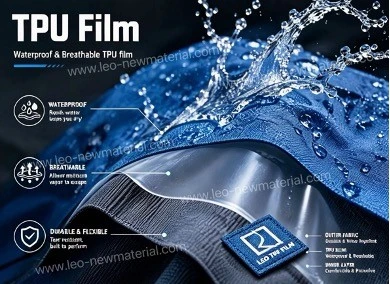
Polyether TPU has become a mainstream film material in the fields of waterproof and breathable applications, medical devices, and inflatable products. Compared to conventional polyester TPU, its key advantages are resistance to hydrolysis, resistance to heat and moisture, and excellent low-temperature toughness, making it ideally suited for long-term use in humid environments or under conditions of significant temperature fluctuations. Consequently, it has emerged as a popular material for material substitution within the industry in recent years.
The fundamental difference in performance between the two materials stems from their distinct molecular structures. The soft segments of polyester-based TPU feature ester groups, which are highly susceptible to erosion by water vapor under high-temperature and high-humidity conditions; once the polymer chains break down, the film surface may become tacky, its strength may drop sharply, and it can rapidly deteriorate or fail after short-term use. In contrast, polyether-based TPU employs stable ether linkages, making it resistant to water penetration and degradation; consequently, it exhibits superior hydrolysis resistance, mold resistance, and low-temperature rebound performance. Its only limitations are slightly lower tensile strength and oil resistance compared to polyester-based materials.
A key point to note: Pure polyether material does not equate to absolute hydrolysis resistance; rather, it simply exhibits superior resistance to hydrolysis. There are three critical points you must be aware of.
1. The rigid segment still contains urethane bonds and will undergo slow degradation under prolonged exposure to high temperature and high humidity; however, the degradation rate is significantly lower than that of polyesters.
2. Even when both products are labeled as "polyether TPU," differences in hydrolysis-resistant additives, residual catalyst content, and hard segment ratios can result in durability variations of several-fold; it is essential to request a strength retention report after accelerated hydrolysis testing rather than relying solely on the claim of "hydrolysis resistance."
3. TPU is highly prone to moisture absorption; if it is not sufficiently dried prior to extrusion, hydrolysis may initiate during the processing stage, which can subsequently lead to a matte finish, bubble formation, and premature cracking.
Key Selection Parameters
When selecting polyether TPU, you should not rely solely on hardness; instead, you should evaluate multiple criteria comprehensively:
• Conventional hardness: A75–A95; higher hardness corresponds to greater strength but reduced ductility.
• Tensile and tear strength: determine the products resistance to pulling forces and damage
• Elongation at break: Ensures no cracking under repeated bending
• Low-temperature performance: retains flexibility at-40 °C, making it suitable for outdoor and cold-chain applications
• Breathability and hydrostatic pressure: Balancing breathability and waterproof performance based on the fabrics intended use
The film thickness directly affects overall performance: the thinner the film, the better its breathability, but its water resistance and pressure resistance will correspondingly decrease; therefore, the selection of the appropriate film thickness requires a balance based on actual operating conditions.
Comparison of TPU Selection Criteria: Polyether vs. Polyester
Polyether TPU: resistant to hydrolysis and low temperatures, featuring excellent rebound properties and superior mold resistance; ideal for waterproof and vapor-barrier films, medical consumables, inflatable products, and outdoor applications.
Polyester TPU: characterized by high strength and excellent oil and wear resistance, but it is not resistant to wet-heat aging; it is widely used in industrial wear-resistant components, transmission parts, and oil seals.
Simple selection criteria: For humid environments, low-temperature operating conditions, or repeated bending applications, prioritize polyether; for wear-resistant and oil-resistant industrial applications, prioritize polyester.
Key Considerations for Production and Processing
1. Strictly control the drying and dehumidification processes to prevent product defects caused by moisture absorption of raw materials;
2. The processing temperature window of polyether TPU is relatively narrow; therefore, gradient sampling should be conducted in advance to avoid high-temperature yellowing and inadequate plasticization at low temperatures.
3. Prioritize the use of the TPU solvent-free hot-melt lamination process to avoid residual solvent adhesive, which could cause fogging on the film surface and degradation of performance.
Avoid these common pitfalls when processing composite materials.
• Drying Control: Once opened, use the product as soon as possible; prior to extrusion, dry according to the process curve (reference: 80–100 °C, 2–4 h). Exceeding the specified moisture content threshold may readily lead to the formation of silver streaks and bubbles.
• Pay attention to the processing window: The process window of polyether TPU is narrower than that of polyester; if the temperature is too high, yellowing and degradation may occur; if it is too low, insufficient plasticization may lead to the formation of crystallization points. For new raw materials or new equipment, it is recommended to first conduct temperature gradient trials.
• Composite adhesive selection: When bonding with fabric, prioritize the use of TPU hot-melt adhesive film; the residues of solvent-based adhesives can easily penetrate the film, leading to fogging and contradicting the trend toward solvent-free adhesives.
Common Product Issue Troubleshooting
Adhesion and reduced tensile strength of the finished product are predominantly caused by wet or hot hydrolysis; white spots on the film surface and uneven atomization are often due to the precipitation of additives or incompatibility between the adhesives; while cracking during cutting and poor rebound performance necessitate adjustments to the film thickness and hardness specifications.
sum up
The core advantage of polyether TPU lies in its long-term stability under demanding operating conditions. When material selection is not driven by a blind pursuit of high performance parameters, but rather involves precise matching based on the operating environment, processing techniques, and test data, it becomes possible to eliminate quality issues-such as aging, hydrolysis, and degradation-at their root, thereby ensuring consistent stability in mass production.